 中文
中文
 English


Composite vs. Cast Iron Rail Brake Shoes: Performance, Economics, and Selection Guide
Editorial & Technical Standards Note: This guide is authored by certified railway mechanical engineers and references rigorous industry standards, including TB/T 3104.1-2020 (Composite Brake Shoes for Rolling Stock). All data points, friction coefficients, and mechanical parameters undergo peer-review to ensure accuracy for fleet operators and procurement specialists evaluating rolling stock components.
In modern railway fleet management, selecting the appropriate friction material for braking systems directly influences operational safety, lifecycle costs, and track noise levels. When searching for high-performance rail brake shoes, fleet engineers and procurement officers are frequently faced with a critical choice: traditional cast iron brake shoes or modern composite friction materials.
While cast iron served as the industry standard for over a century, recent advancements in composite material engineering have significantly shifted global preference toward high-friction and low-friction composite options. This article delivers a comprehensive technical and economic comparison between composite and cast iron options to assist fleet managers evaluating essential railroad parts for sale in today's market.
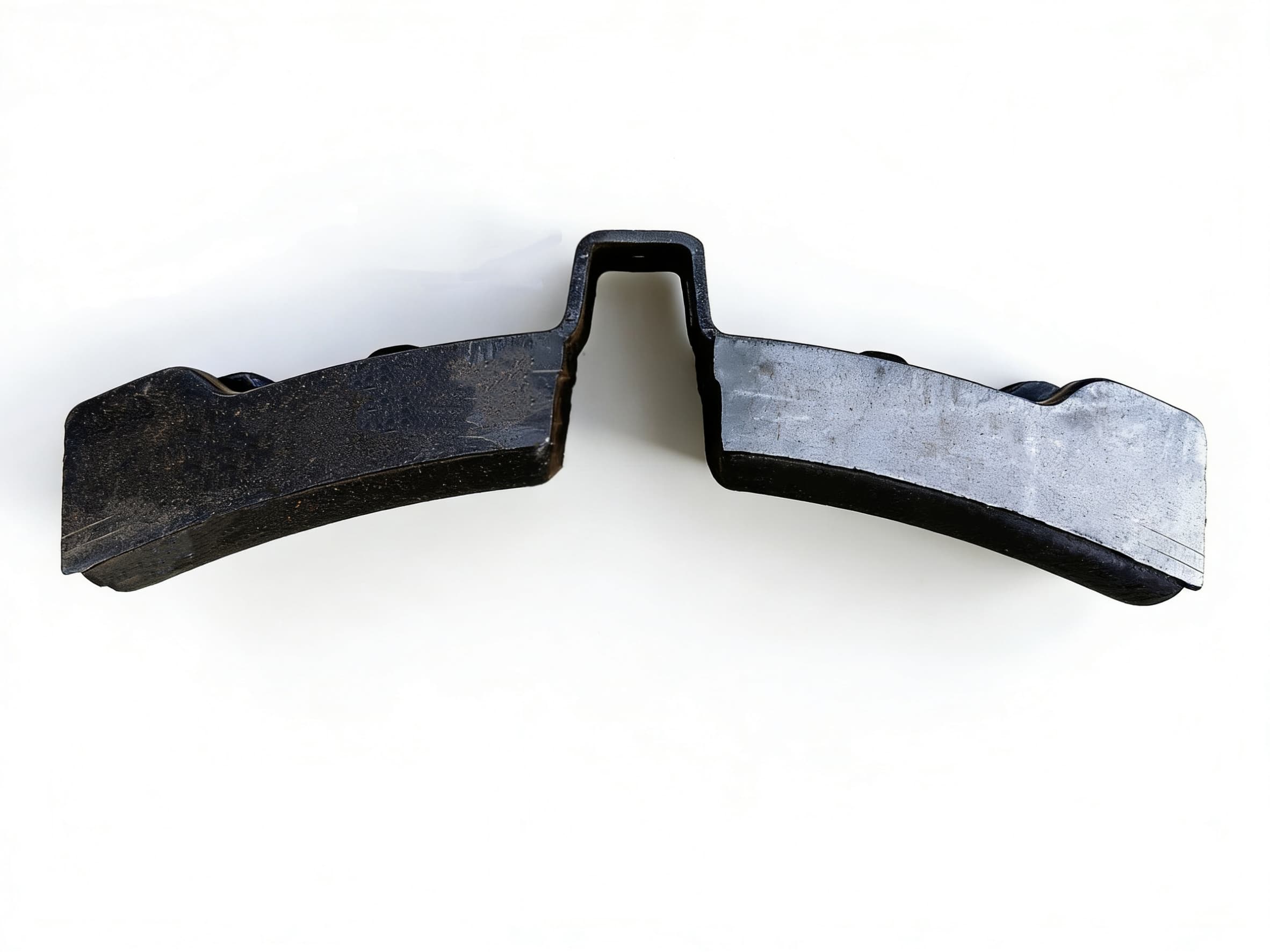
1. Material Composition & Structural Design
Traditional cast iron brake shoes consist of metallic gray cast iron alloys, designed to absorb energy by converting kinetic movement into friction heat. However, their high density contributes to significant weight on bogie assemblies, increasing tare weight and wear on mechanical linkages across heavy-duty railroad parts.
In contrast, modern high-performance composite brake shoes feature an engineered multi-component structure. According to the TB/T 3104.1-2020 standard, composite units consist of a heavy-duty steel back plate and an advanced friction body composed of binder resins, synthetic reinforcing fibers, and friction modifiers. When upgrading critical rail brake shoes, this lightweight construction drastically reduces un-sprung weight while maintaining superior structural integrity.
Key Structural Standard Requirements (TB/T 3104.1-2020):
- Rockwell Hardness: ≤ 100 HRR / ≥ 30 HRX
- Compressive Strength: ≥ 25 MPa
- Bending Strength (Class H): ≥ 8 MPa
- Impact Strength: Up to ≥ 3.0 kJ/m² for high-capacity locomotive units (JH2/LH2/LH3)
2. Friction Behavior and Thermal Performance
One of the primary technical differences between cast iron and composite friction materials lies in their friction coefficient stability across varying speed profiles and operating temperatures.
Cast iron exhibits a sharp increase in friction coefficient at low speeds (the "speed effect"), which can cause aggressive jerk during complete stops. Conversely, composite materials are engineered to maintain a much flatter, predictable friction curve across the entire braking cycle.
Furthermore, under rigorous testing on 1:1 dynamometer test benches, quality composite rail brake shoes demonstrate outstanding thermal resistance. According to standard specifications, composite friction elements must withstand:
- Instantaneous Peak Surface Temperature: 450°C
- Continuous Maximum Operating Temperature: 300°C
3. Comprehensive Technical Comparison Matrix
To assist procurement managers evaluating commercial railroad parts for sale, the following matrix summarizes key operational, economic, and safety metrics between Composite and Cast Iron options:
| Performance Metric | Composite Brake Shoes (TB/T 3104.1) | Traditional Cast Iron Brake Shoes |
|---|---|---|
| Friction Coefficient Range | Class H: 0.30 – 0.43 Class L: 0.12 – 0.25 | 0.08 – 0.20 (Highly variable with speed) |
| Wear Rate | ≤ 1.0 cm³/MJ (Extremely Low Wear) | High (Requires frequent replacement) |
| Noise Emission | Low noise; keeps wheel tread smooth | High noise; prone to tread roughness |
| Weight per Shoe | Lightweight (~3.5 - 5 kg) | Heavy (~12 - 15 kg) |
| Wheel Tread Impact | Prevents severe groove wear and thermal cracks | Higher risk of heat spots and mechanical scoring |
| Wet Friction Stability | Maintains min. average friction (≥0.21 Class H) | Significant friction drop in wet conditions |
4. Application in Heavy-Haul Freight and Passenger Trains
When selecting high-quality railroad parts for braking upgrades, matching the friction level to the specific locomotive or wagon type is vital:
- Class H (High-Friction) Composite Shoes: Specifically designed for heavy-axle freight cars (up to 27t - 30t axle loads under LH1 standards) and high-power mainline electric/diesel locomotives (JH1/JH2). Their high friction capability allows for lower brake cylinder pressures and smaller brake cylinders.
- Class L (Low-Friction) Composite Shoes: Engineered as direct functional replacements for cast iron shoes on existing rolling stock without modifying original brake rigging setups. They provide stable braking performance up to 90 km/h for axle loads up to 21t.
5. Maintenance and Economic Total Cost of Ownership (TCO)
Although the initial acquisition cost per unit for composite materials may be slightly higher than raw cast iron, the operational total cost of ownership (TCO) leans heavily in favor of composites when sourcing railroad parts for sale:
- Extended Service Life: With wear rates under 1.0 cm³/MJ, composite shoes last significantly longer, reducing depot maintenance downtime and labor costs.
- Wheel Protection: High-grade composite shoes are formulated to ensure metallic inclusions fall off freely during operation, eliminating severe wheel tread scoring and extending wheel turning intervals.
- Reduced Fuel & Power Consumption: Lower overall un-sprung weight across multi-car trains contributes to measurable energy savings over long-distance routes.
6. Conclusion and Sourcing Recommendations
Choosing the right brake shoe technology is a key decision for railway safety, efficiency, and maintenance budgeting. While cast iron remains in niche legacy applications, composite friction materials fully comply with modern rail standards (such as TB/T 3104.1-2020) and deliver superior friction stability, extended durability, and reduced environmental noise.
Looking for Premium Railway Components?
Explore our certified inventory of heavy-duty rail brake shoes and high-performance friction assemblies tailored for international railway standards.










